Colour Trading: The Round, the Odds and Your Money
Thirty seconds, one generated number, one bet. This site is about what happens inside that round — what each market pays, what an hour of it costs, and which of the decisions on screen are actually decisions.
Table of Contents
What Players Say About the Rounds
Four notes from players in India, edited for length. They are impressions rather than evidence, and the unflattering ones are here too.
I played for two months before anyone told me what the payout on a colour bet actually is. Once I worked out what a night of thirty-second rounds costs, I moved to the slow tables and stopped losing track of it.
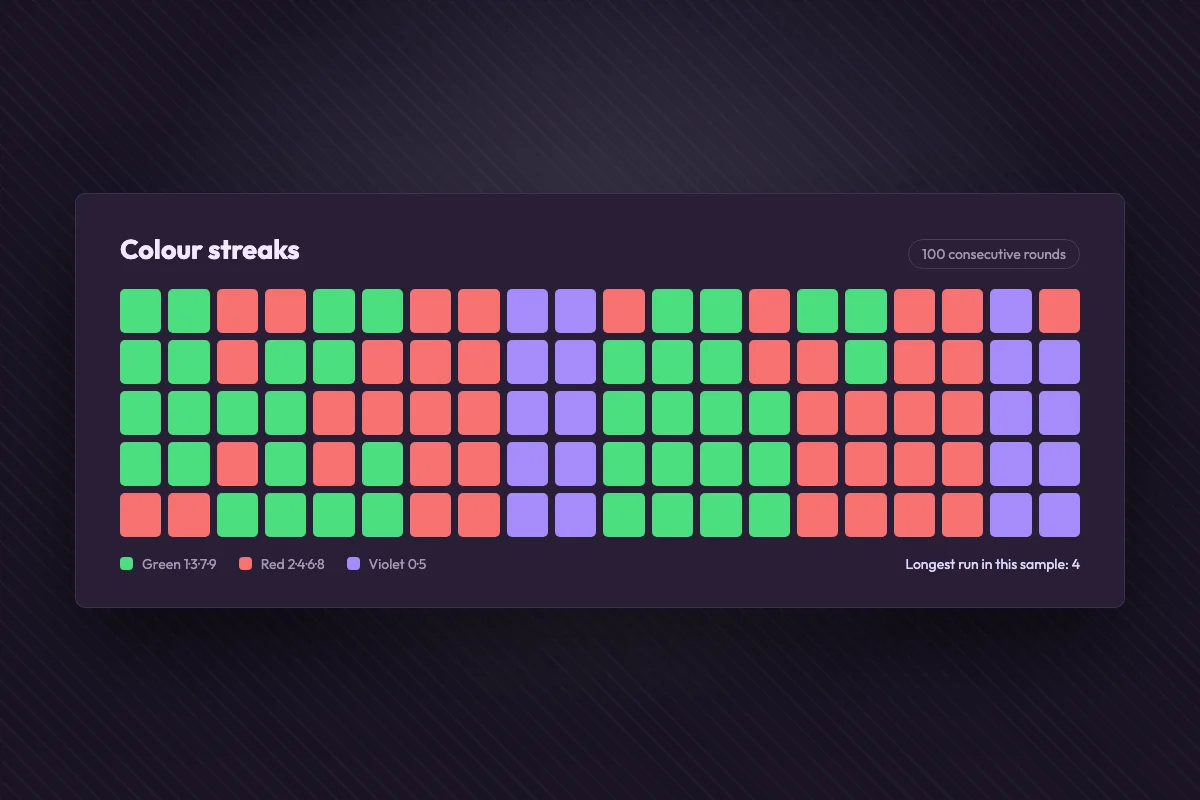
The history strip was the thing that fooled me longest. Five reds in a row genuinely looks like information, and it took a notebook and a week to convince myself it is not.
Two recovery systems, both explained very confidently. Both worked until the evening they did not, and that evening cost more than every good week before it.
The advice that helped was the dullest one on this site: decide the number of rounds before opening the app. Not the money, the rounds.
One Number, Three Ways to Bet on It
Everything on this site refers back to a single sequence: a digit is generated after betting closes, and every market on screen is settled against that one digit. Once that is clear, the rest of the interface becomes readable.
Learn More
Colour
Two main colours cover roughly half the digits each, with one or two rare digits assigned a third shade that pays much more.
Big or small
Five digits each, close enough to an even-money bet. The simplest market on the board and the cheapest per round.

Exact number
One digit in ten, paying around nine times. The largest share retained by the operator and by far the widest swings.
All settled together
A single digit resolves every market at once. Moving between them changes your coverage and payout, never the thing being predicted.
What the Round Looks Like
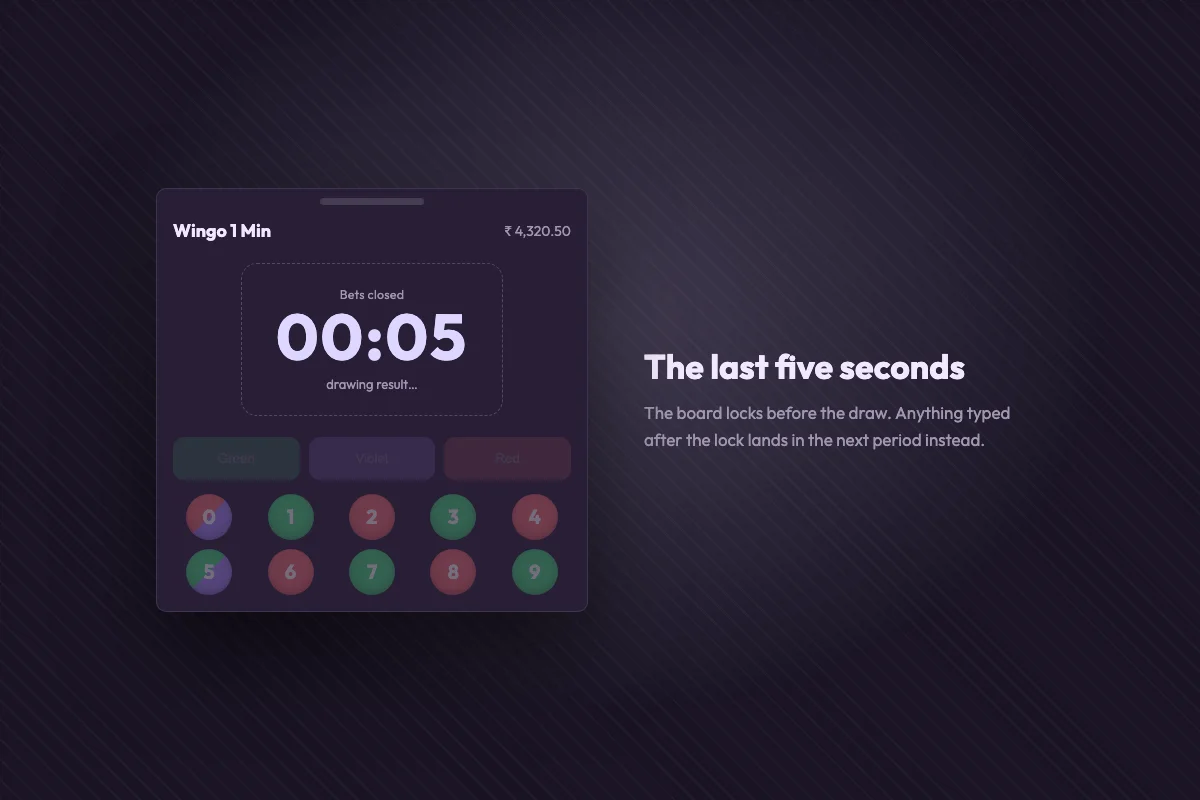
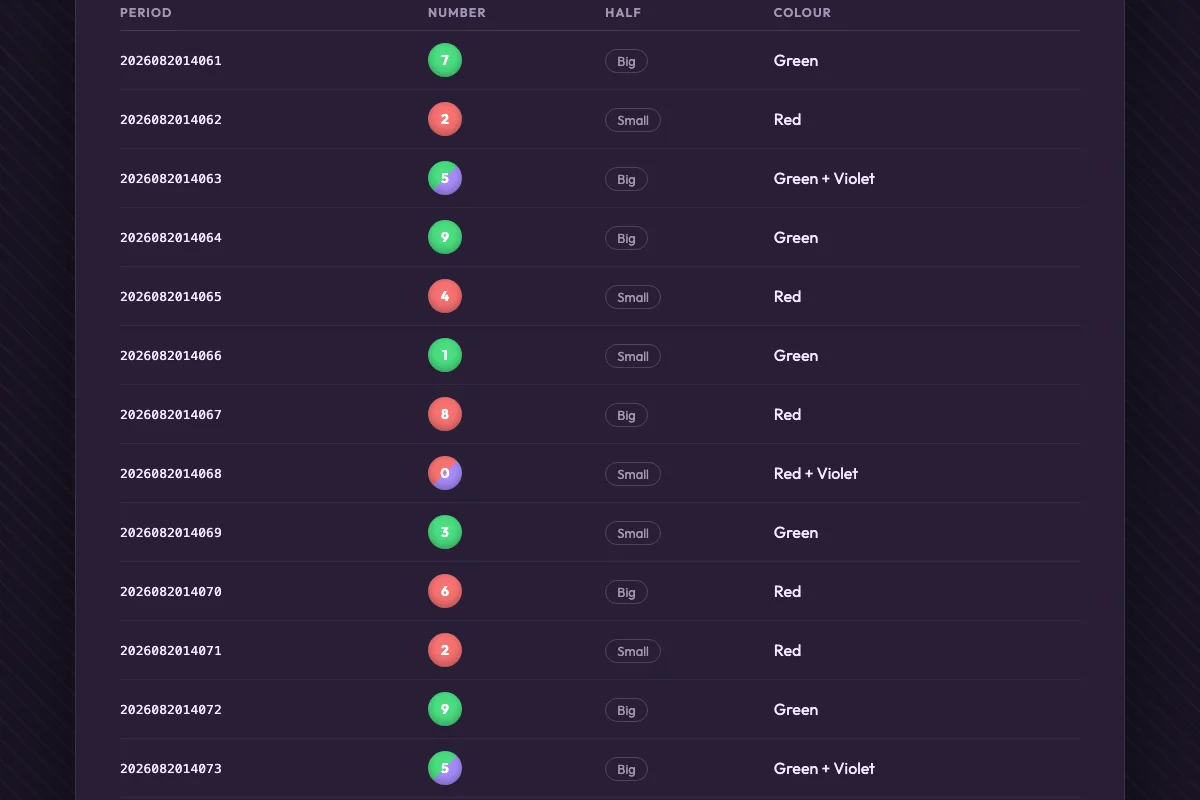
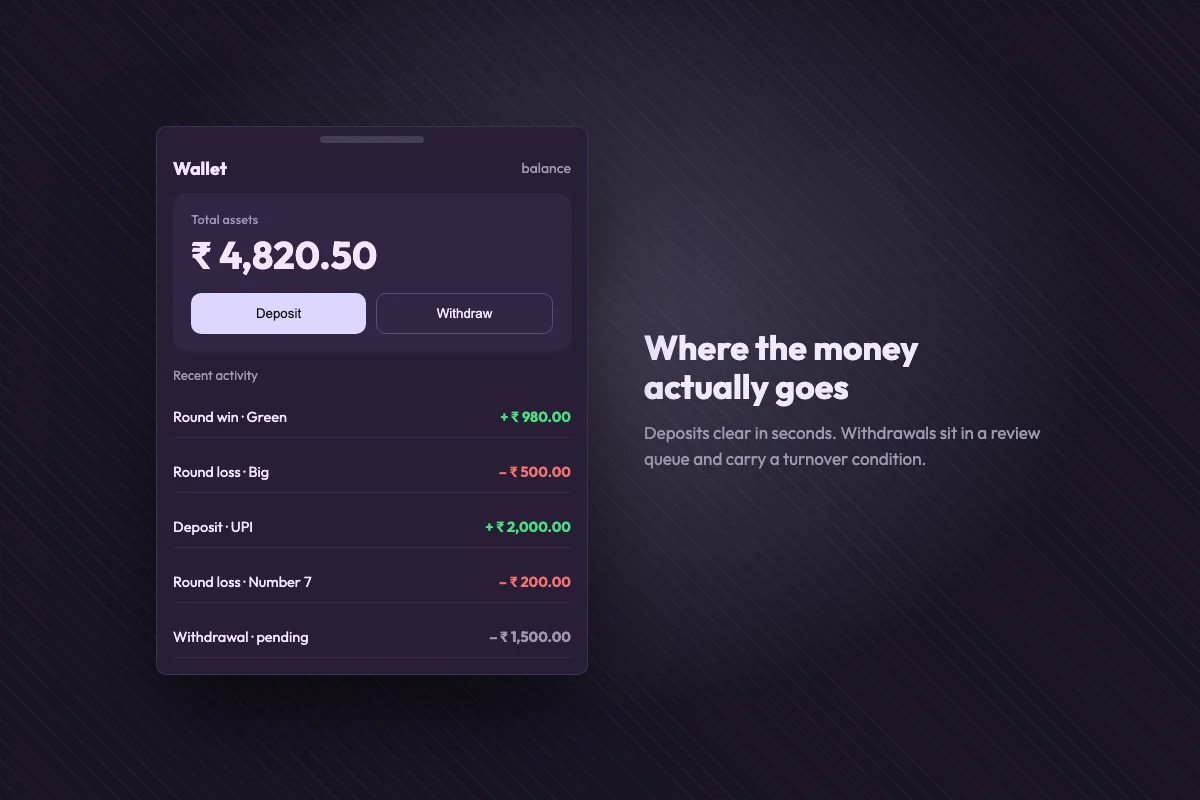
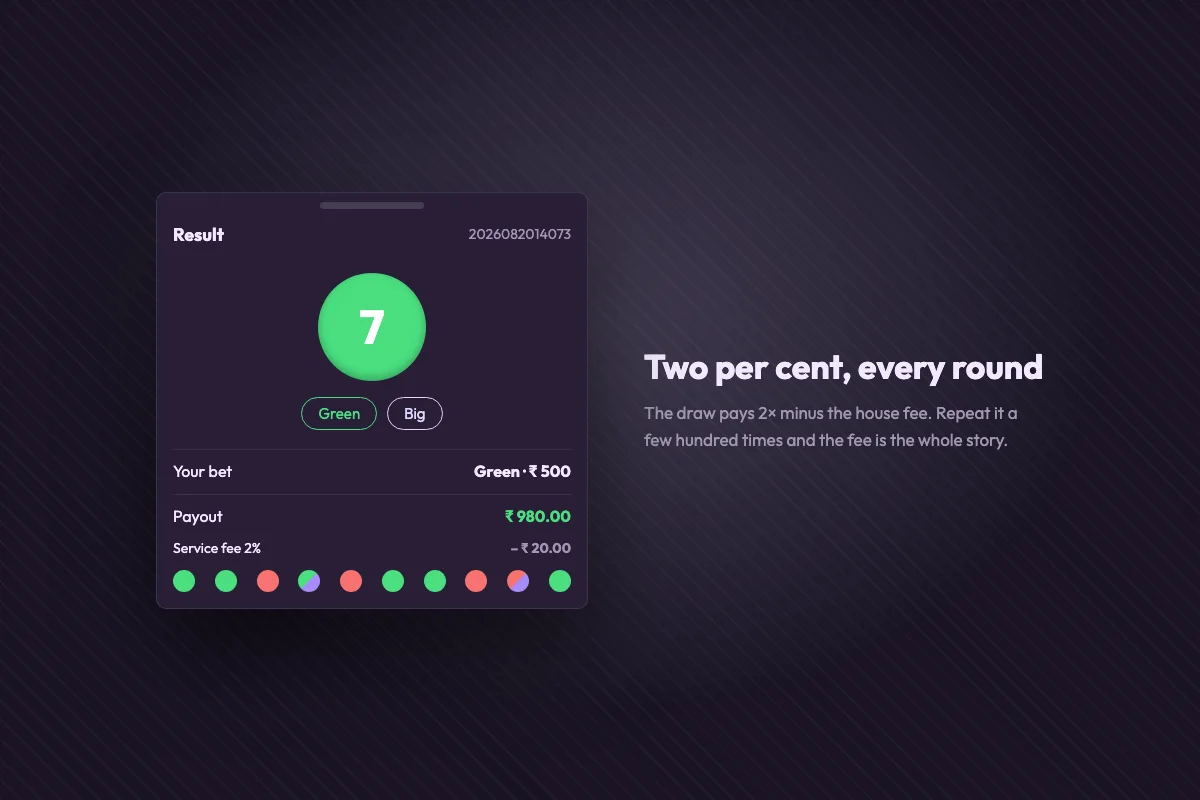
Five panels from the interfaces in circulation, captioned with what each one actually shows. Nothing here is a forecast — every screen is a record of something that has already settled.
What Happens in Thirty Seconds
Four moments, in fixed order. Only one of them contains a decision, and it happens before the timer runs out rather than after.
Betting opens
The timer starts and the markets accept stakes. Nothing about the outcome exists yet, on any server or on your phone.
Betting closes
A few seconds before the round ends. From this point your position is locked and no further information reaches you.
The digit is generated
On the operator's infrastructure, after the lock. This is the stage every prediction product implicitly claims to reach.
Settlement
Winning markets are paid at the published multiplier and the next round opens. Nothing is carried forward except your balance.
Three Ways to Play an Hour, With the Cost Written Out
Same odds in every column. What changes is how much money passes through the game, which is the figure the house edge is applied to.
Standard hour
Fifty rupees a round on a one-minute timer.
- About ₹90 of expected cost across the hour
- Fifty rounds an hour at a steady pace
- Even-money markets only, at one stake
- A session length agreed before opening the app
- Balance checked at the end, not during
Careful hour
Ten rupees a round on a five-minute timer.
- About ₹4 of expected cost across the hour
- Twelve rounds an hour, with time to stop
- The cheapest way to spend an evening on this
Fast hour
Fifty rupees a round on a thirty-second timer.
- About ₹180 of expected cost across the hour
- One hundred and twenty rounds an hour
- Twice the cost of the standard hour, same odds
Chasing hour
Stakes raised after each loss, on any timer.
- Expected cost rises with every raise
- Turnover no longer decided in advance
- The pattern behind most memorable losses
What You Actually Control
None of them is a prediction. All four are set before the round opens, and between them they decide what an evening costs.
The market you bet on
Even-money colour and size bets retain the smallest share per round. The exact-number grid retains the most and swings the hardest.
The size of the stake
Multiplied by rounds played, it becomes turnover. Halving it halves the expected cost of the session with no other change.
The timer
Thirty seconds and five minutes carry identical odds and a tenfold difference in how often those odds are applied to your money.
When you stop
Counted in rounds rather than minutes, and decided before the first one. This is the only limit that survives a losing run.
The whole of the strategy, in one line
You cannot change what the next digit will be. You can change how many digits your money passes through, and that is where every real decision in this game lives.
Learn More
Six Things Worth Knowing Before the Next Round
None is a system and none improves your chances. All six change what an hour of play actually costs.
The number nobody tracks
Stake multiplied by rounds played. It only moves in one direction and it is what the house edge is charged on.
Rounds have no memory
The generator keeps no record of what it produced five minutes ago. A run of one colour owes nothing to the other.
Payout follows coverage
A market paying nine times covers a tenth of the outcomes. Bigger multipliers are priced against how rarely they land.
Speed multiplies everything
Same odds, ten times the rounds. The clock setting is the most consequential control in the interface.
No tool reaches the digit
It is produced after betting closes on servers no consumer app touches, which is why the prediction market cannot work.
Rounds, not minutes
A session counted in rounds maps directly onto cost. A session counted in time stretches to fit whatever is happening.
FAQ
What is colour trading in simple terms?
+
How much does an hour of play cost?
+
Can the next colour be predicted?
+
What is the safest way to play?
+
